- The Coffee Break
- Posts
- ☕️ WFH saves fuel but hidden costs could amount to RM1 bil per month, says business group
☕️ WFH saves fuel but hidden costs could amount to RM1 bil per month, says business group
US, Iran agree to ceasefire, but relief may be fleeting. Terminator in the making - Anthropic halts release of latest AI model, Mythos. Ejaculation and the quality of sperm health.


Finance Finlit & The Coffee Break
April 09, 2026

Starting the day with this poll:
Do you know what is Macau Scam?More about it in tomorrow's issue. |
1. MARKET SUMMARY 📈
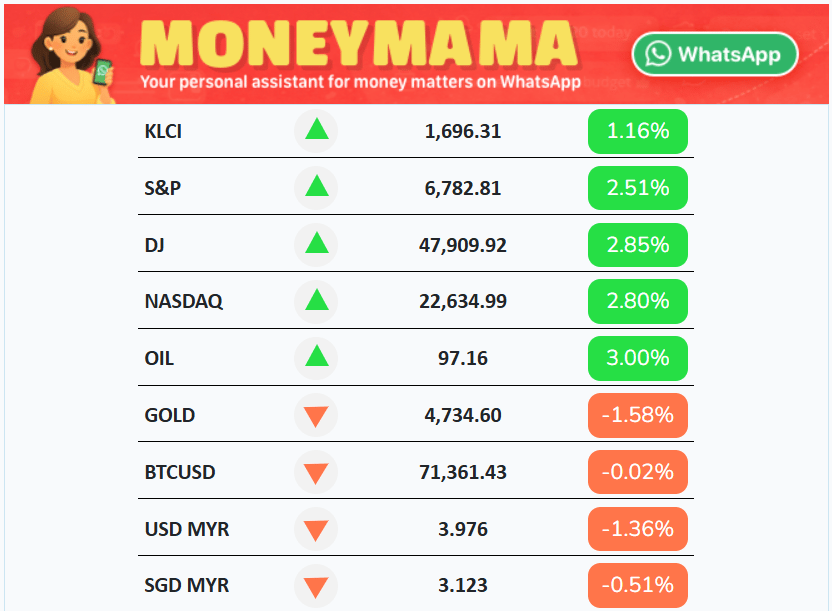
2. NUMBERS AT A GLANCE 🔢
USD1.24 bil (RM4.93 bil) – That’s how much it will cost the Indian government to conduct its census of the country’s population this year. Not only is this the world’s largest census, but it is also controversial because it will include caste enumeration for the first time in nearly a century. The year-long exercise will see more than three mil Indian officials surveying about 1.4 bil Indians on their household composition, living conditions, and access to basic amenities. The last census was conducted in 2011, with the 2021 census delayed due to the COVID-19 pandemic. The caste system is among the world’s oldest forms of surviving social stratification, believed to be more than 3,000 years old, and 1,000 years before Christ was born. Learn more about India’s caste system here.
More than 95% – That’s the percentage of Indian smartphones that run on Google’s Android operating system, with the remainder on Apple’s iOS, according to Counterpoint Research. The world’s most populous nation introduced a mandate requiring smartphone makers to preload a state-owned cyber safety app called Sanchar Saathi on all new devices, to the outrage of the public, the opposition party, and civil rights groups. The app was downloaded more than 14 mil times, helped block over 4.2 mil stolen or lost phones, and terminated more than 30 mil fraudulent mobile connections. The mandate was revoked a week after it was announced.
1.12 bil – That’s the number of smartphone shipments expected in 2026, a 12.9% drop that would mark the global smartphone market’s biggest decline in more than a decade. The drop is expected due to surging memory chip prices (no thanks to AI demand), which would drive up device costs, according to the International Data Corporation. The decline is predicted to hit low-end Android manufacturers the hardest, while Apple and Samsung are poised to gain market share as smaller rivals struggle or exit the market entirely.
3. IN MALAYSIA 🇲🇾
Fuel policy in focus
Cooking gas prices remain unchanged: Concerns about rising cooking gas prices in Malaysia have been eased after the Ministry of Domestic Trade and Cost of Living clarified that the cost of subsidised household LPG has not changed. A viral social media post from a company in Negeri Sembilan suggested otherwise, prompting confusion among the public, especially as energy costs remain sensitive due to recent tensions in the Middle East.
The ministry explained that the price adjustment mentioned in the post applied only to commercial cylinders. Specifically, the C14C (14 kg commercial) cylinder increased by RM14 per unit, while the C50 (50 kg commercial) cylinder went up by RM50. Household cylinders remain subsidised, and the ministry assured that there is no immediate impact on domestic users who rely on LPG for daily cooking. Households can report unverified information or lodge complaints with KPDN via WhatsApp at 019-848 8000, or the KPDN e-Aduan portal.
MyKad-based diesel aid under study: The government is exploring whether the MyKad subsidy mechanism, successfully used for RON95 petrol under the Budi95 scheme, could also be applied to diesel. Finance Minister II Amir Hamzah said the MyKad system has proven effective in reducing leaks and delivering subsidies without significantly changing the way Malaysians purchase fuel.
Officials noted that diesel consumption patterns differ across the country, particularly in Sabah and Sarawak, where it is widely used for road and water transport, electricity generation, and machinery. Remote areas without conventional petrol stations would also need alternative delivery methods if the scheme were expanded.
WFH savings may come at a cost: While fuel subsidy reforms are under consideration, business groups warn that broader cost-saving measures such as large-scale work-from-home policies could have unintended consequences. The Federation of Malaysian Business Associations (FMBA) said that although fewer commuters may reduce fuel subsidy spending, the wider economic impact could outweigh any savings. The federation estimated that the Klang Valley alone could face monthly losses of between RM320 mil and RM495 mil due to weaker consumer spending. Once economic multipliers are included, losses could rise to RM480 mil to RM1 bil a month. Petrol stations, small businesses, and service sectors are particularly at risk, as reduced commuting affects sales and foot traffic.
Hot on crime: Raids, graft and loan shark threats
Suspended senior police officer linked to RM4.4 mil robbery ring: A major robbery in Kuala Lumpur has resulted in the arrest of six men, including a suspended senior police officer, in connection with a series of armed break-ins targeting wealthy foreign nationals. The incidents occurred in Kepong on Apr 5, affecting two Chinese nationals and an Indonesian woman aged between 29 and 52. The suspects allegedly posed as police officers before forcing their way into homes and stealing three luxury vehicles – a Rolls-Royce, a Bentley, and a Toyota Alphard – along with cash, jewellery, gold bars, and a safe. Total losses are estimated at RM4.4 mil.
Police later seized two pistols, five vehicles, multiple mobile phones, and cash in various currencies. Kuala Lumpur police chief Comm Datuk Fadil Marsus said the suspended officer is believed to have coordinated the group’s activities. Two of the suspects, licensed personal bodyguards, supplied the firearms used in the crimes.
RM5 mil bribery probe hits private university: In a separate case, the MACC arrested four individuals, including two lecturers from a private university, over an alleged RM5 mil bribery and embezzlement scheme. The other two detainees are an oil company officer and the director of an engineering company.
Investigators said the group worked together to secure research projects for companies in exchange for illicit payments, while also siphoning off university research funds. The alleged activities took place between 2019 and 2025. Two external parties reportedly acted as proxies to receive and transfer payments on behalf of the lecturers. Funds were allegedly moved in cash as well as through personal bank accounts. As part of the investigation, authorities froze 70 bank accounts holding around RM8.5 mil and seized seven vehicles.
Loan sharks accused of outsourcing threats: Meanwhile, concerns about illegal money lending have intensified after claims that overseas syndicates are paying local runners to harass borrowers and their families. Syndicates, believed to be based in Singapore, are recruiting locals through social media to carry out intimidation and violent acts in exchange for cash. Runners are allegedly paid RM500 to splash red paint on homes and RM700 to throw Molotov cocktails. These costs are added to the borrower’s debt as service charges, with total repayment sometimes swelling to 10 times the original loan. Syndicates are also targeting neighbours and extended family members to increase pressure. For example, a case in Rawang where a man was threatened over a loan taken by an uncle he had not contacted in nine years. Flyers featuring his family photos were distributed, and threats were made against the house and neighbouring homes.
4. AROUND THE WORLD 🌎
US, Iran agree to truce, but relief may be fleeting
Pakistan has successfully brokered a two-week ceasefire between the US and Iran, suspending a six-week war that has killed thousands, spread across the Middle East, and disrupted global oil supplies like never before. However, the relief seen in Middle Eastern streets and global financial markets may be fleeting, and Israel continuing and escalating its war in Lebanon may be an early sign.
Both the US and Iran claimed victory after the ceasefire was agreed, two hours before US President Donald Trump’s deadline to reopen the Strait of Hormuz. However, their main disputes remain unresolved, with Washington and Tehran sticking to competing demands for the peace deal being negotiated. Official peace talks are expected to begin in Islamabad on Friday, and while Trump has promised that the US will work closely with Iran as the two countries discuss tariff and sanctions relief, Iran’s economy did not emerge from the war unscathed.
Even as Trump praised Iran’s current leaders for having undergone “a very productive regime change”, Iran remains isolated, with an economy in tatters, little prospect of rapid recovery, and an impoverished, embittered population. The war left many Iranians jobless at a time when prices for everything have surged. Worst of all is how Iran’s critical trading relationships with the other Gulf countries have been severed, with no imminent recovery in sight. Sanctions relief and the release of frozen funds will be a necessary part of any peace agreement, as Iran has no money to rebuild its lost infrastructure. Its major industries have been severely impacted, and the broken economy could very well spur new rounds of protests.
However, Iranian leaders have proposed a system for fully loaded oil tankers to pay a toll in cryptocurrency and other digital payments during the ceasefire. The proposed system will make it compulsory for tankers to email cargo details to Iranian authorities, who will levy a toll of USD1 (RM4.03) per barrel. The system will also instruct crews on how to settle the fee in digital assets. Hamid Hosseini, spokesperson for Iran’s Oil, Gas and Petrochemical Products Exporters’ Union, said that this will allow Iran to monitor what goes in and out of the strait to ensure the two-week ceasefire is not used for transferring weapons.
Ghost Murmur: Finding anyone by their heartbeat
In the race to recover the US airman who was shot down in southern Iran, the CIA used a futuristic new tool that uses long-range quantum magnetometry to find the electromagnetic fingerprint of a human heartbeat. The tool, dubbed Ghost Murmur, then pairs the data with AI software to isolate the signature from background noise. The rescue operation marked the tool’s first field test. A source likened the use of the device to “hearing a voice in a stadium”, adding that, in the right conditions, “if your heart is beating, we will find you”. The rescued airman, known publicly as Dude 44 Bravo, was hiding in a mountain crevice after he was shot down. He survived two days in desolate terrain as Iranian troops scoured the area looking for him to claim the bounty on his head.
'Teapot' refineries, and how is China using them to protect itself from the oil crisis
Teapot refineries are small, privately owned oil refineries shaped like compact teapots that are based primarily in China’s Shandong province, used by Beijing to import discounted Iranian and Russian oil. This allows China to avoid the reputational and financial risk of importing sanctioned oil. Teapot refineries account for a full quarter of China’s processing capacity but operate on very narrow margins, leaving them extremely sensitive to fluctuations in oil prices. An analyst remarked that the teapot refineries boost fuel supply and margins in normal times, but act as a flexible buffer for bargain barrels during crises.
These refineries have been keeping the Chinese economy stable with the imported sanctioned oil throughout the Iran conflict but will not be able to make up the difference for long because most of their current oil stocks were bought before the war. Now they face high replacement prices in a market already strained by global tensions. However, China has granted them additional crude import quotas to allow them to continue producing fuels at officially mandated levels. This concession, given before the ceasefire was agreed to, is aimed at keeping fuel production high and bolstering domestic energy security. Still, the concession will not support the heavily pressured profit margins of the refineries. Beijing reportedly told the teapot refineries to keep fuel output stable at 2025 levels, even if they have to incur losses.
No relief for airlines, travel firms just yet
The welcome news of the ceasefire is unlikely to provide immediate relief to the global aviation industry, which is facing its worst crisis in years. The International Air Transport Association has warned that it would take months for jet fuel supplies to recover even if Iran reopened the Strait of Hormuz, as Middle East refining capacity has been disrupted due to the conflict. While oil fell below USD100 (RM403) per barrel after the ceasefire was announced, it will take time for tourism to recover due to the inflated costs and disrupted schedules of airlines.
AI and robots
Anthropic: Claude Mythos broke containment during testing
Anthropic announced that it has halted the broader release of its newest AI model, called Mythos, due to concerns that it is “too good at finding high-severity vulnerabilities” in major operating systems and web browsers. Instead, Anthropic will be using Mythos as part of a defensive cybersecurity programme with a limited set of partners. The AI firm also revealed that Mythos could follow instructions that encouraged it to break out of a virtual sandbox. The model succeeded in breaking containment, demonstrating a potentially dangerous capability to circumvent safeguards. At this time, Anthropic has decided not to publicly release Mythos, but hopes to eventually release “Mythos-class models” once proper safeguards are in place.
Grab turns to robots, AI to navigate logistical challenges
SEA ride-hailing giant Grab is planning to introduce Carri, a physical automation robot, as a superhuman extension of Grab’s delivery riders. According to co-founder and group CEO Anthony Tan, Grab’s drivers lose 10% of their earning time locating a restaurant in a big mall or waiting for customers to pick up their deliveries from large office towers. The idea is that Carri can take on the task of finding the restaurant and passing the order to the driver, allowing them to move to the next job much more quickly. The firm also intends to deploy autonomous vehicles and closed-circuit television cameras, reaffirming its commitment to being an AI-first, heart-led platform that ensures AI benefits everyone, including the underserved communities.
5. FOR YOUR EYES 📺
Health matter matter$
A close friend’s mum was recently diagnosed with early-stage breast cancer. Medical bill will cost RM400k, but thank god there’s insurance. Ever wonder if you are properly insured to cover critical illnesses, not under, not over-insured, etc.? Register here if you are keen to explore our financial health check tool.

Ejaculation and the quality of sperm.

Harvard Medical School - where the science of medicine meets the art of cooking.