- The Coffee Break
- Posts
- ☕️ National Education Blueprint - Malaysian education system gets major revamp
☕️ National Education Blueprint - Malaysian education system gets major revamp
Maybank to drop RM10 bil on tech, AI, MAE to be replaced. ASEAN-China Code of Conduct for South China Sea in final stage. Study: USD200 bil tariffs paid mostly by Americans.


Finance Finlit & The Coffee Break
January 21, 2026

1. MARKET SUMMARY 📈
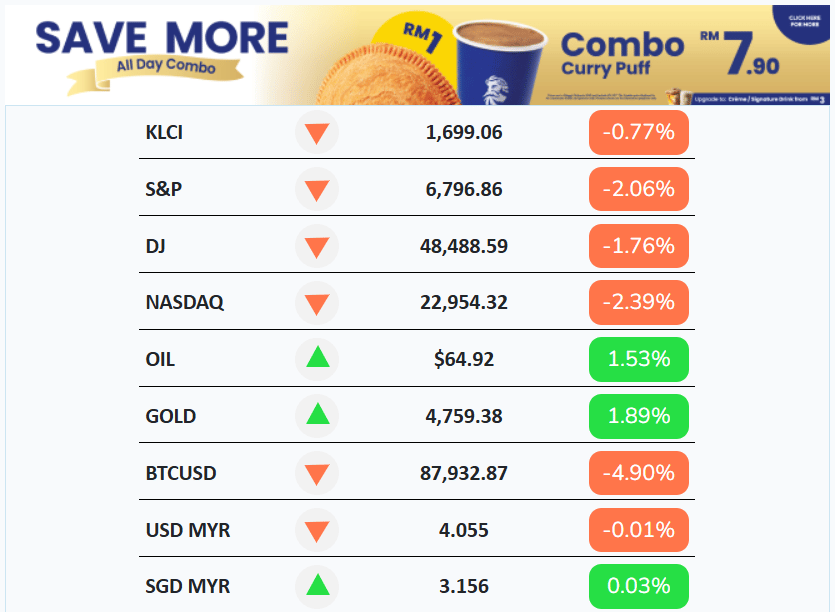
2. NUMBERS AT A GLANCE 🔢
South Korean electronics giant Samsung aims to have 800 mil mobile devices with its ‘Galaxy AI’ features by the end of the year. This is double the 400 mil the company reached in 2025. The AI features are largely powered by Google’s Gemini, and this 800 mil-device target should give Google a firm edge over its rivals in the global AI race. According to co-CEO T. M. Roh, the goal is to apply AI to all products, functions, and services as quickly as possible. He also warned that, while Samsung is a chipmaker, the global memory chip shortage will still impact the company. However, he added that Samsung is working with its partners to lessen the impact.
A survey of 1,250 professionals by AI startup Anthropic found that 69% were wary of the social stigma of using AI in the workplace. This has led to AI users in the workplace taking to sneaky behaviour, such as dimming their screens and checking their surroundings before querying their preferred AI. Business Insider coined a term to describe such users, calling them ‘AI creepers’. Anthropic’s report also revealed that certain industries may be especially prone to judgement from their peers. Out of 125 creative professionals surveyed, 97% said AI saves them time, but 70% also reported peer judgement about using AI.
In other professions that frown upon AI, US courts and law firms face a growing problem of AI hallucinations in legal briefs. Such briefs drafted with AI chatbots can be riddled with fake cases hallucinated by the AI to support legal arguments. In 2025, a legal data analyst and consultant began tracking cases in which a court had discovered hallucinated content in a legal filing. That single court alone saw 120 such cases between Apr 2023 and May 2025. However, by Dec 2025, the number had grown to 660, with the rate of new cases accelerating to up to five cases per day. While this remains a relatively small number compared to the total volume of legal filings, the trend is concerning. As such, startups have stepped up to address the problem. One such firm is Clearbrief, which offers AI-powered software to scan legal briefs for made-up facts. So basically, using an AI to catch AI.
3. IN MALAYSIA 🇲🇾
National Education Blueprint - Malaysian education system gets major revamp
Standard 1 starts age 6 (optional)
If you’re a parent, this one matters: school starting ages, exams and assessments in Malaysia are about to change. Starting next year, children in Malaysia will begin pre-school at age five and enter Standard 1 at age six. The change will not be compulsory in its first year, with parents given the option to hold back if they feel their child is not ready. Simultaneously, Bahasa Malaysia exams will become compulsory for students in private and international schools, religious schools, and those taking the UEC. A new standardised assessment will be introduced for Year 4 pupils, covering BM, English, Science and Mathematics, while the Form Three Learning Measurement for BM, English, Mathematics, Science and History will also be rolled out. The Education Ministry will be required to offer optional Chinese, Tamil and Arabic language subjects, and five primary and five secondary schools in each district will be upgraded to improve facilities and education quality.
No UPSR, PT3 comeback; focus shifts to classroom-based assessments
There will be no comeback for the UPSR and PT3 exams, confirmed Education Minister Fadhlina Sidek, saying the system has moved on and there is no reason to turn back. Speaking after the launch of the National Education Plan 2026-2035, she stated the exams no longer suit students at their current ages and that the focus now is on moving forward under the new education blueprint. UPSR and PT3 were scrapped in 2021 and 2022, and their return has been widely debated with a possible review hinted earlier this month. Fadhlina commented the ministry firmly maintains its stance. Instead of exam-heavy assessments, schools will continue with classroom-based evaluations that examine students more holistically. However, public feedback has led to the introduction of a new standardised Malaysian Learning Metrics test for Year Four and Form Three students, and the results will be used to identify students who may need early support before finishing primary school or sitting for SPM.
Free higher education for students with disabilities
Students with disabilities studying at public universities, polytechnics, and community colleges will now receive free education, a move that takes effect immediately and covers about 3,000 students. PM Anwar Ibrahim said the step is part of a broader push to widen access to higher education, following an earlier announcement that waived fees for around 5,800 students from poor families. Support for students from financially vulnerable families will also be stepped up through PTPTN, with expanded assistance set to benefit up to 10,000 students.
Constitution and Malaysian history now compulsory in universities; 5,000 new student housing spots
Starting this year, all Malaysian students in public and private universities will have to take general education courses on the Federal Constitution and Malaysian history, taught fully in Malay. The move ensures students across all fields gain a basic understanding of the nation’s legal and historical foundations. The government will add 5,000 new student accommodation places this year, with government-linked investment companies leading the development in partnership with universities.
In others
ASEAN-China Code of Conduct for South China Sea in final stage
ASEAN and China are now in the final stretch of closing the long-discussed Code of Conduct for the South China Sea, with the process expected to be completed this year. Foreign Minister Mohamad Hasan said talks are being handled strictly through ASEAN-led mechanisms and involve only countries with direct interests, rejecting the idea of bilateral approaches. He also pushed back against claims that ASEAN has failed to manage regional disputes, pointing to the Thailand-Cambodia border issue, where Malaysia continues as a facilitator at the request of both sides, even after handing over the ASEAN chair to the Philippines in 2026. Regarding Myanmar, Mohamad said ASEAN does not recognise the elections held on Dec 25, 2025, and Jan 11, as they lacked full participation, adding that Malaysia did not send any representatives or observers for the same reason.
Maybank to drop RM10 bil on tech, AI, MAE to be replaced
Maybank plans to invest RM10 bil in technology over the next five years, including a new app to replace MAE and expanded use of AI across its platforms, under its ROAR30 strategy. The strategy focuses on four priorities: building a resilient foundation, adopting AI and machine learning to boost productivity, delivering top-notch user experiences, and enabling new ways of working for employees. The bank has already spent RM1 bil on tech under its M25+ strategy since Oct 2022. No launch date has been set for the new app, but retail-focused features are in development, with updates due later this year. All investments will be funded internally, with no fundraising, while Maybank will implement efficiency measures across the group, including workforce planning, procurement discipline, branch optimisation, and productivity improvements to balance the spending.
4. AROUND THE WORLD 🌎
Make Trump Go Away
Europe can actually “weaponise” USD13 tril of US assets over Greenland - but will they?
While Europe still seems “reluctant” to stand up strongly against the US, there is one extreme potential countermeasure that is fuelling debate among investors. Deutsche Bank calls it “weaponisation of capital”, where the European countries could sell trillions of dollars of US bonds and stocks that it holds, potentially driving borrowing costs higher and equity prices lower, given the US reliance on foreign capital.
US assets held within the European Union (EU) amount to over USD 10 tril, according to US Treasury data, with more in the UK and Norway. However, the bulk of these assets is held by private funds outside the control of governments, and, in any case, such a move would likely hurt European investors too, shooting themselves in the foot.
Strategists say that the European public sector investors in US assets can either stop accumulating or start selling, but the situation probably needs to escalate a fair bit further before they damage their investment performance for political purposes. The most tangible reaction from the EU so far has been a proposal to halt approval of its July trade deal with the US.
In theory, it works. In practice, it nukes everyone around the world, including us in Malaysia. FYI, the US is the biggest debtor in the world. Its actions now is akin to showing the middle finger to its lenders. Binged too much debt that they have become too big to fail.
Iran warns attack on Khamenei would be a declaration of war
In an apparent response to speculations that Trump is considering an attempt to assassinate or remove Iran’s supreme leader, Ayatollah Ali Khamenei, President Masoud Pezeshkian has posted on X that such an attack would be “tantamount to a full-scale war with the Iranian nation.” Trump, in an interview with Politico on Saturday, had called for an end to Khamenei’s nearly 40-year reign, calling him “a sick man who should run his country properly and stop killing people”. Pezeshkian also said in his post that the hardships and constraints in the lives of the people of Iran are mainly caused by the longstanding hostility and inhumane sanctions imposed by the US government and its allies. The situation has returned to calm in Iran, with no more new protests, but witnesses reported some Iranians chanting anti-Khamenei slogans from the windows of their homes on Saturday night around neighbourhoods in Tehran, Shiraz and Isfahan.
Trump’s tariff: It’s the people who pay the price
A study (read here) by a German think tank, Kiel Institute for the World Economy, has revealed that American buyers are the ones who bear the brunt of Trump’s tariff, particularly at 96%. Meanwhile, 4% of the tariff burden was paid by foreign exporters. It also said that the USD 200 bil increase in customs revenue that the US government raised in 2025 was a “tax paid almost entirely by Americans.” The Kiel study explained that American importers and wholesalers are first hit by the tariff cost, followed by manufacturers and retailers, all of which must choose whether to absorb the tariff or pass it on to their customers. American consumers are then hit by increased prices, both on imported goods and American-made products that use foreign inputs. The research contradicts Trump’s messaging that tariff costs would not be paid by Americans, and echoes the findings from other research including the one from Harvard Business School and The Budget Lab at Yale. While the damage can be undone by the US Supreme Court, Trump had said that the US would be “screwed” if the tariffs are overturned.
Shorts
A lot fewer Chinese tourists are visiting Japan
Japan has reportedly seen its high-spending Chinese tourists almost halved in December amid the country’s bitter diplomatic row with Beijing over the security of Taiwan. Japan’s transport ministry said that the number of Chinese tourists has dropped to about 45% from the same month a year earlier to about 330,000. China has long been the biggest source of inbound tourism, with almost 7.5 mil Chinese arriving in Japan in the first nine months of 2025 – accounting for a quarter of all foreign visitors, according to official figures. Chinese tourists to Japan spent a combined USD3.7 bil in the third quarter of last year. Nevertheless, Japan continues to be a popular destination for foreign visitors, with a record 42.7 mil flocking to the country last year, comfortably surpassing the previous record, set in 2024, of almost 37 mil.
Guatemala declares state of emergency over multiple prison gang violence
A 30-day nationwide state of emergency has been declared in Guatemala (view map here) to combat criminal gangs after authorities accused them of killing 8 police officers and holding hostages at three prisons across the country. The measure suspends the right of assembly and permits individuals to be arrested and interrogated without a court order. 10 other police officers were wounded in the retaliatory attacks, and 1 suspected gang member was killed. Since Saturday morning, inmates had been holding 45 guards and a psychiatrist hostage to protest against the transfer of gang leaders to a maximum-security prison, but authorities had managed to retake control of all three prisons by Sunday.
NYSE - another step closer to 24/7 trading
The New York Stock Exchange has announced its development of a platform for trading and on-chain settlement tokenised securities, which will enable tokenised trading experiences, including 24/7 operations, instant settlement, orders sized in dollar amounts, and stablecoin-based funding. Subject to regulatory approvals, the platform will power a new NYSE venue that supports trading of tokenised shares fungible with traditionally issued securities as well as tokens natively issued as digital securities. The launch of the platform is part of its broader digital strategy, which includes preparing its clearing infrastructure to support 24/7 trading and the potential integration of tokenised collateral.
5. FOR YOUR EYES 📺
Subject: Why dead bodies can still move, learning from whale DNA to fight cancer, and the engineering of retention walls
Why dead bodies can still move? Let science, not dark arts, explain.

Bowhead whales might hold the key to fighting cancer despite Peto’s Paradox - the puzzling observation that large, long-lived animals don’t get proportionally more cancer than smaller, shorter-lived animals . Embed not loading, so pls view it here.
Retention walls are a common sight along our highways. Here’s the science and engineering behind these walls.

Relax Session: The Bro word - different tone, different meaning.